

Your City Has a Digital Twin. So Does Your Heart. So Does the Bridge You Drove Over This Morning
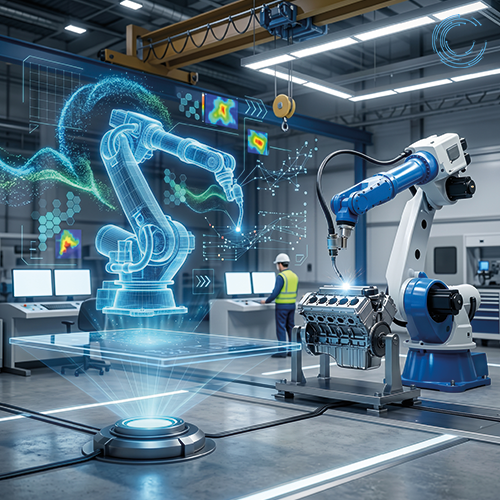
Something extraordinary is happening and almost nobody outside of engineering circles is talking about it. | Digital Twin Technology Right now, somewhere in Singapore, city planners are running a simulation of tomorrow’s traffic before tomorrow exists. They are testing what happens if they close a road, reroute a bus line, or hold a stadium event — in a virtual model so precise it accounts for individual street corners and real-time weather. Then they make the actual decision. Based on what the simulation told them. The city has a twin. A digital one. And it is running slightly ahead of reality. What a Digital Twin Actually Is A digital twin is not a 3D model. It is not a dashboard. It is a living, dynamic replica of a real thing — a machine, a building, a body, an entire city — that updates in real time from sensor data and can be used to simulate what happens next. The real object and the digital twin are in constant conversation. The physical sends data. The digital processes it, runs scenarios, and sends back insight. Decisions get made on the twin before they are executed on reality. That gap between simulation and action is where billions of dollars of waste, risk, and human error are being eliminated. Where It Is Already Running Rolls-Royce has digital twins of every engine it manufactures. Each engine streams operational data mid-flight — temperature, vibration, fuel efficiency — to its twin, which runs predictive models continuously. Maintenance is scheduled before failure happens. Not after. Airlines using this system have cut unplanned downtime significantly, which in commercial aviation translates directly into hundreds of millions in saved costs. Siemens built a digital twin of an entire factory in Amberg, Germany. The physical factory and the digital model are so closely synchronised that engineers test new production configurations virtually before touching a single machine on the floor. The plant runs at over 99 percent quality rate — among the highest of any manufacturing facility on the planet. The human body is next. Dassault Systèmes has been developing what it calls the Living Heart Project — a functioning digital twin of the human heart that responds to simulated drugs, surgical interventions, and device implants. Surgeons are beginning to rehearse complex procedures on a patient’s specific digital twin before making a single incision. The twin is built from the patient’s own scans and data. It behaves like their heart — not a generic model. Why AI Made This Possible Now Digital twins are not a new concept. The idea goes back to NASA in the 1960s — they maintained physical replicas of spacecraft on the ground to mirror what was happening in orbit. But building a twin used to require extraordinary resources and was limited to the most critical, expensive systems. Three things changed. Sensors got cheap and ubiquitous. IoT infrastructure now generates the real-time data streams that feed a twin continuously. Cloud computing made it economical to run complex simulations at scale. And AI — specifically machine learning — gave twins the ability to not just mirror reality but to model it forward, predicting what will happen under conditions that have never occurred before. The intelligence layer is what turned a fancy mirror into a decision engine. What This Means for Every IT Team Digital twins are moving from aerospace and manufacturing into every infrastructure-heavy industry — energy, healthcare, construction, logistics, smart cities, and enterprise facilities management. If your organisation manages physical assets — data centres, office infrastructure, supply chains, industrial equipment — the question is not whether a digital twin approach is relevant. It is whether you are building the data architecture that makes one possible. Twins require clean, continuous, well-labelled data from connected systems. Teams that are investing in IoT infrastructure, edge computing, and unified data pipelines today are not just solving today’s problems. They are building the foundation for a capability that will define operational advantage over the next decade. The Bigger Picture We are moving into an era where consequential decisions — medical, civic, industrial, logistical — are increasingly made in simulation first. The real world becomes the place where validated decisions are executed. The digital twin is where you find out if they are right. That is a profound shift in how humans relate to risk, planning, and uncertainty. And it is already running — in the engines overhead, in the hospitals beginning to rehearse surgery on data, in the city systems managing roads you drive on every day. Your twin is out there somewhere. It is learning. And it is slightly ahead of you. TeamITServe helps enterprises build the connected data infrastructure behind next-generation capabilities — from IoT architecture and edge computing to AI-powered operations. If your organisation is thinking about where digital twin strategy fits, that is a conversation worth starting now.